
Episode 341: How to Increase Your Capacity for Happiness — A Conversation with Dr. Peggy DeLong, The Gratitude Psychologist™
What If Happiness Isn’t Something You Chase — It’s Something You Build? Most of us have been told, in one…

What If Happiness Isn’t Something You Chase — It’s Something You Build?
Most of us have been told, in one way or another, to just be happy. Just let it go. Just choose joy. And if you’ve tried that and found it deeply unhelpful, you are in very good company.
Dr. Peggy DeLong is back on the podcast for her third visit, and what she shares in this episode about how to increase your capacity for happiness is not what most people are teaching. It’s not about ignoring what’s hard. It’s not about thinking positively until the feeling kicks in. And it has nothing to do with luck or your current circumstances.
Peggy is truly one of my favorite people on planet Earth, and I know you are going to love this conversation with her.
In this episode, you’ll hear:
- Why the most common message about happiness — just push the pain aside — actually makes things worse
- What Dr. Peggy means when she says your capacity for joy is in direct proportion to your capacity to feel emotional pain
- The simple, free methods Peggy used to survive the worst days of her life — and what the research says about why they work
- How human connection with complete strangers can predict happiness as much as your closest relationships
- What the three Ps — present, pleasure, and purpose — have to do with breaking the high-achieving cycle that so many of us are stuck in
- Why purpose doesn’t have to be enormous — and what Viktor Frankl actually said about finding it
Listen to the full episode
Watch the Full Episode
We Cannot Heal What We Don’t Feel
Peggy was 26 when her fiancé was diagnosed with an aggressive cancer. He passed away seven months later. Then her father died. She and her mother — two young widows — found themselves living together, figuring out how to keep going.
It was during those days of sitting by her fiancé’s side, not knowing if he would be able to speak or open his eyes when she arrived, that she discovered what gratitude actually was. Not the Instagram version. The real thing. And what it looked like for Peggy was a cup of hazelnut coffee — predictable, warm in her hands even through a styrofoam cup, smelling like home, connected to memories of drinking it with her mother in high school. That cup was the one thing she could count on when nothing else was certain.
And it was during that same time that something else became clear: she was not going to get through this by pushing the grief away.
“We cannot heal what we don’t feel.” — Dr. Peggy DeLong, citing Edith Eger
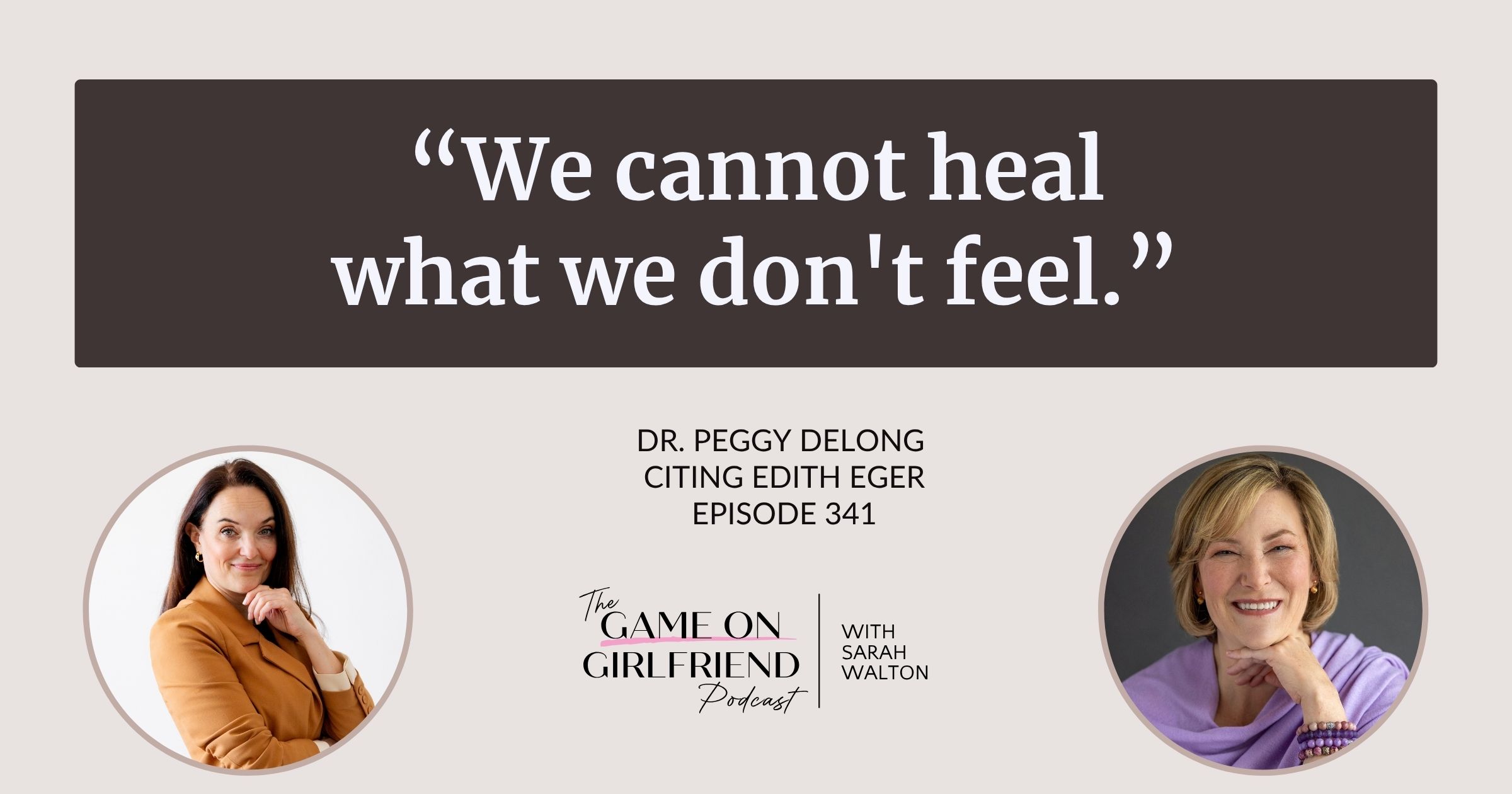
One of the biggest misconceptions we’re given — often by well-meaning people, parents, teachers, social media feeds — is that in order to be happy, you need to set the painful feelings aside. Peggy says that is one of the most damaging things we’ve been taught. Our capacity to experience joy is in direct proportion to our capacity to process and feel emotional pain. They are not opposites. They are the same muscle.
What Fear of Feeling Actually Looks Like
The most common fear Peggy hears after thirty years as a therapist is not about the pain itself. It’s about getting stuck there. People are afraid that if they let themselves really feel something, they won’t come back out. That’s a valid fear, she says, and it deserves to be taken seriously.
Her approach: feel it, and then know what works for you to move forward.
Therapeutic journaling is one of the most research-supported tools for this. Psychologist James Pennebaker’s work found that writing about a traumatic experience for fifteen to twenty minutes helps people process and organize it in a way that even talking sometimes doesn’t. It helps move the feeling through rather than leaving it somewhere it has to be carried.
For Peggy, it was that cup of hazelnut coffee and her journal that got her through the worst stretch of her life. Twenty-five years later, that journal became a memoir. But the purpose of it wasn’t publication — it was survival, and then healing.
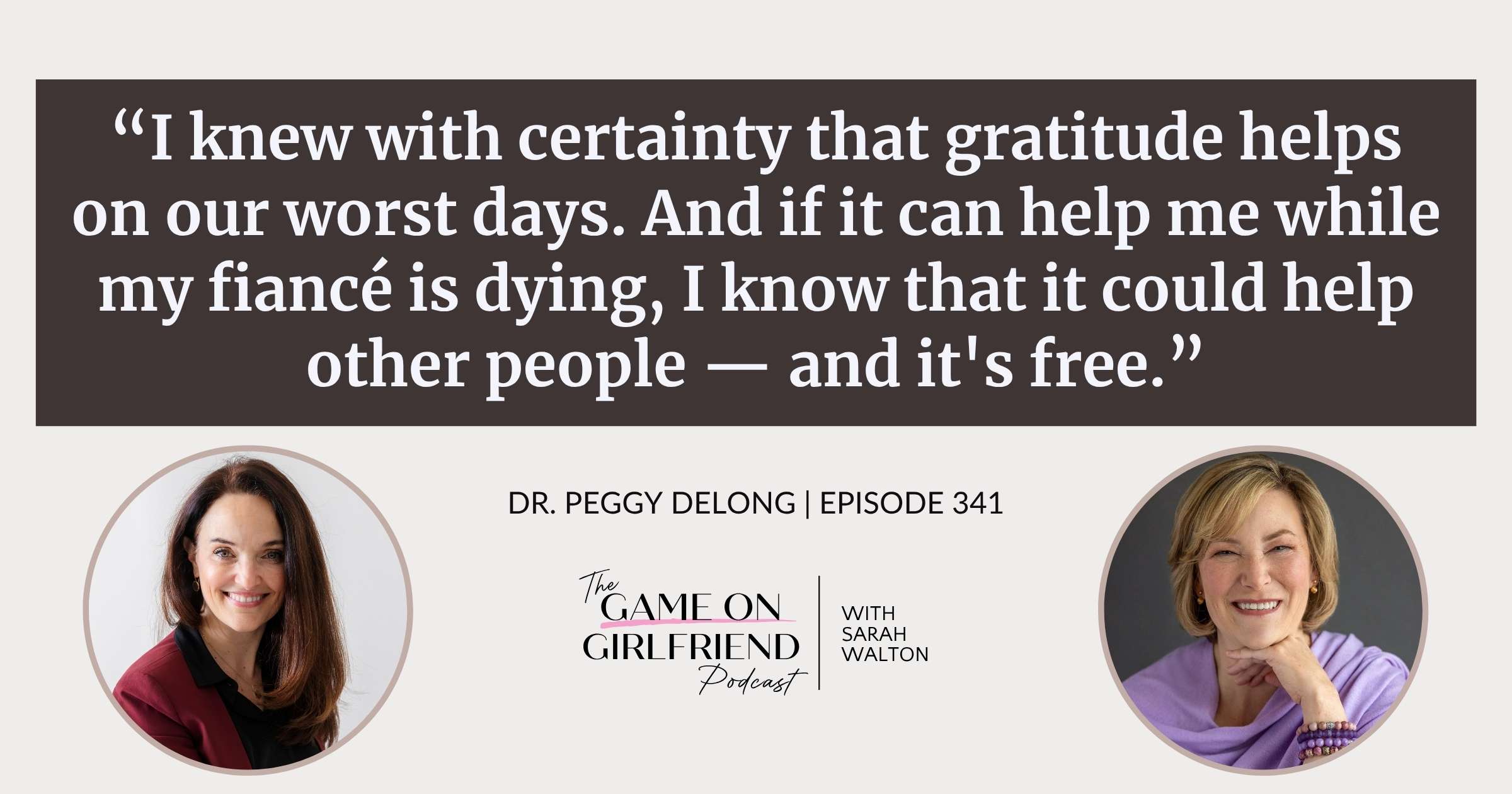
“I knew with certainty that gratitude helps on our worst days. And if it can help me while my fiancé is dying, I know that it could help other people — and it’s free.” — Dr. Peggy DeLong
After you’ve allowed yourself to feel, she says, then you turn to what works for you to come back. For Peggy, it’s nature, exercise, and a good friend. For each person, it’s different. The work is learning what yours are.
The Research on Joy That No One Talks About
Peggy talks about something called collective effervescence — that feeling of being at a concert and singing along with strangers, or at a sporting event where everyone in the room is cheering together, or at a church service, feeling connected to the person sitting next to you. Psychologist Dacher Keltner has studied awe extensively, and he outlines eight ways we can experience it. All of them are free. Moral beauty is one of them. Collective effervescence is another.
And then there’s water. Wallace J. Nichols’ research in Blue Mind documents the ways that simply being near water — or in a shower, or even running water over your hands — shifts our brains toward calm and connection. Peggy has a lesson in her program she calls the trifecta of exercise in nature: specifically seeking out awe, water, and trees. Not because it’s poetic, but because the science shows it works.
I told Peggy about my shower moments — those times when the ideas just arrive. Turns out that’s not random either. Our brains know, with some predictability, that the next ten minutes belong to us. That predictability itself creates the space for something new to come through.
Connection with Strangers and Why It Counts More Than You Think
Here’s something that surprised me in this conversation: the research shows that our connections with complete strangers predict happiness at roughly the same level as connections with our closest people. And most of us are constantly opting out of those micro-connections.
Peggy has a practice she calls Prioritize People in Public. When you have the option of a self-checkout or a person, choose the person. Use their name. Make eye contact. Give a genuine compliment. Ask a question. She uses the acronym A-L-L — anything, like, and learn — as a simple guide for talking to a stranger. Anything is a fine starting point: the weather, the traffic, whatever’s in front of you. Like is a genuine compliment — someone’s nails, their sweater, something real. Learn is asking something you’re actually curious about.
Research by Nick Epley at the University of Chicago found that people who talked to strangers on trains — even people who clearly looked like they didn’t want to be bothered — reported more happiness afterward. And so did the people who were talked to.
The inventor of the ATM told Laurie Santos on The Happiness Lab that it was one of his biggest life regrets. His own wife never used one, because she knew what was waiting for her inside the bank: a teller who would ask about her ankle surgery, about her grandchildren. Those things matter. We know they matter. We’ve just optimized them away.
“When you look at another person, oxytocin is released in that person’s brain, making them feel cared for. So simply by you making eye contact with somebody, you are helping them to feel seen — and then that gets reflected back to you.” — Dr. Peggy DeLong
The High-Achieving Cycle — and How to Start Breaking It
When achievement becomes attached to self-worth — which happens gradually, over years — a shift in your role (kids leave home, a career winds down, a business changes) can feel like a loss of who you are. That’s not a character flaw. That’s what happens when the identity has been built around output rather than being.
Her antidote is the three Ps:
- Present — actually being where you are, not transferring money during yoga
- Pleasure — asking, while you’re doing the thing, why you’re doing it and whether you’re enjoying the process, not just anticipating the outcome. If you’re writing a book, Peggy says, you may not hold the finished copy for two years. So you’d better find something to enjoy today.
- Purpose — Viktor Frankl identified three ways we build it: through human connection, through our attitude toward inevitable suffering, and through creating, making, and doing.
That last one — creating, making, and doing — connects to something Peggy mentioned about using your hands. Decorating a bicycle. Making bracelets. Cross-stitching. The research shows it quiets the negative chatter in the brain. It’s meditative in a real neurological sense.
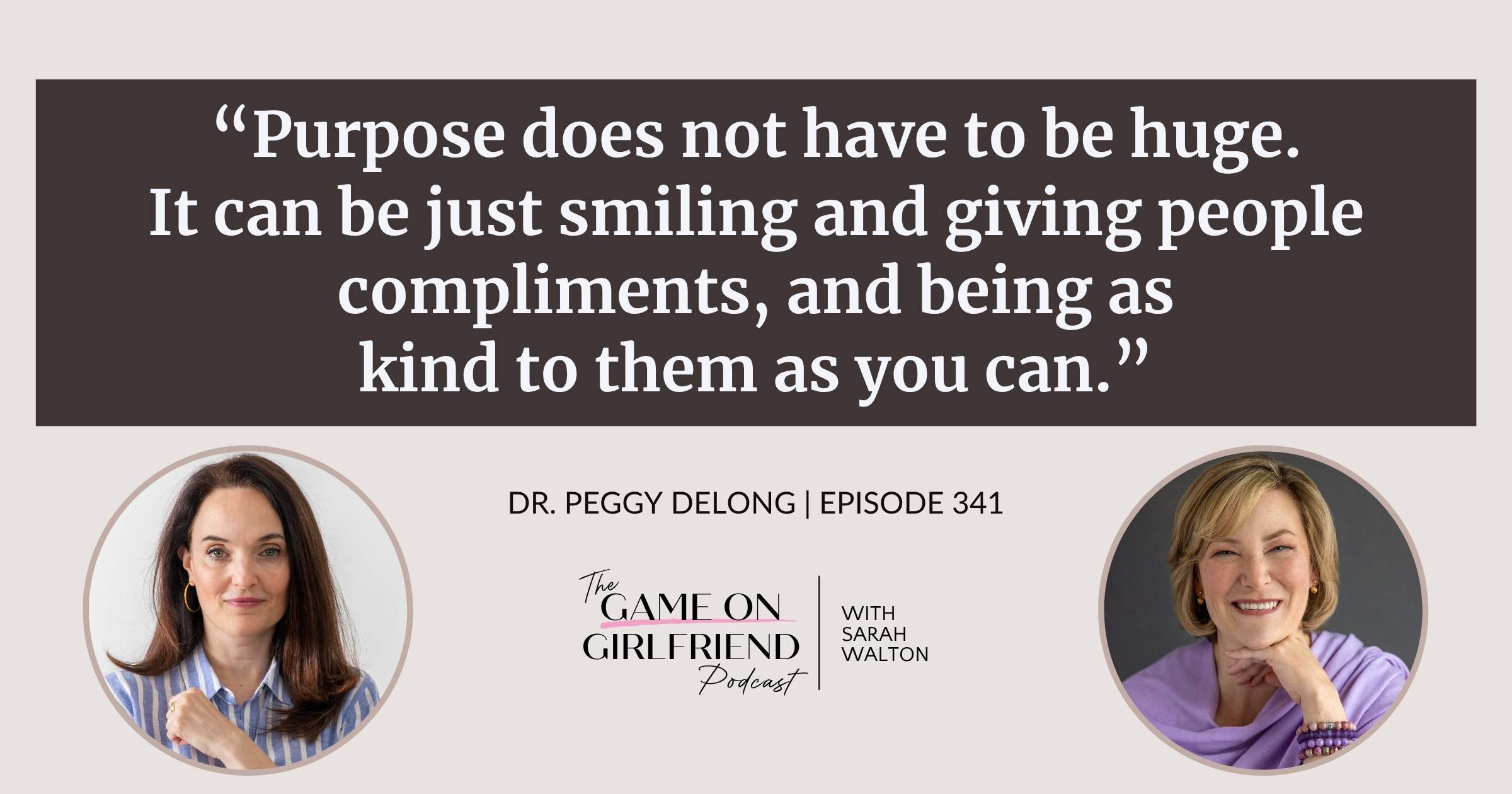
“Purpose does not have to be huge. It can be just smiling and giving people compliments, and being as kind to people as you can.” — Dr. Peggy DeLong
Peggy’s Four Ps for Positive Mental Health
At the end of our conversation, I asked Peggy to leave us with one thing. She gave us four.
Positive mental health doesn’t happen by luck or magic. It’s built by people who make intentional choices to protect and support it:
- Prioritize — your mental health
- Plan — health-promoting activities
- Practice — them consistently
- Prosper — even during hard times
About Dr. Peggy DeLong
Dr. Peggy DeLong, known as The Gratitude Psychologist™, is an internationally recognized expert in gratitude, positive psychology, mental health, and personal development. She helps individuals and organizations cultivate greater peace, joy, and fulfillment.
With a Doctorate in Psychology and over 30 years of experience — including her work as a forensic psychologist conducting more than 4,000 evaluations — she brings a rare depth of insight, credibility, and practical wisdom to her work. She has partnered with leading institutions such as Princeton, Penn State, Rutgers, and major healthcare and corporate organizations to deliver transformational programs and experiences.
As a speaker, author, therapist, and coach, Peggy is the creator of The Grateful Day™ and The Prioritize P.E.A.C.E. Method™, empowering people to move from overwhelm to clarity and emotional well-being. She is also the founder of multiple community-based initiatives and the Your Happy Second Half™ program, where she supports high-achievers in building meaningful connections, rediscovering joy, and living with renewed purpose.
Connect with Dr. Peggy DeLong
- Website: drpeggydelong.com
- Your Happy Second Half: yourhappysecondhalf.com
- Love in a Bracelet: loveinabracelet.com
- Facebook: Dr. Peggy DeLong
- Instagram: @the.gratitude.psychologist
- LinkedIn: Dr. Peggy DeLong
Dr. Peggy’s Free Gifts for Game On Girlfriend® Listeners
- Free: The Grateful Day — a Five Day Challenge with simple practices to build gratitude into daily life. Grab it here
- 20% off — Your Happy Second Half group coaching program. Use code mas at checkout. Learn more here
Related Episodes You’ll Love
Episode 45: Feeling Good with Dr. Peggy DeLong — This is Peggy’s second visit to the podcast, and it’s a beautiful companion to this one. We talked about her book Feeling Good, about processing unwanted emotions, and about why choosing not to feel what’s hard is some of the most damaging advice we’ve been given. If today’s conversation had you wanting more Peggy, start here. Listen here
Episode 201: What It Means to Be an Adversity Warrior with Robin Osborn — Robin had emergency surgery to remove a baseball-sized brain tumor and used the same tools she’d built over decades in business to recover. Her idea of peaks and pre-peaks — that you’re always on the edge of a breakthrough — pairs naturally with Peggy’s work on building purpose through the hard seasons. Listen here
Episode 293: Detours Are Inevitable, Suffering Is Not — Six teenagers stranded on a highway taught me something I hadn’t learned yet about joy and resilience. This episode connects directly to what Peggy says about staying present and not letting circumstances steal your access to happiness. Listen here
My Free Gift to You — Let’s Talk About Your Business
If this episode had you thinking about what you’ve been carrying, what you’ve been pushing through, or what joy you’ve been deferring until later — let’s talk. As my free gift to Girlfriends, I offer a 30-minute discovery call. We’ll talk about where you are right now and what might be getting in the way.
Connect with Sarah
- Instagram: @thesarahwalton
- LinkedIn: Sarah Walton
- Free resources for you
- Join the Game On Girlfriend® community — subscribe to the podcast on Apple Podcasts, Spotify, or YouTube
Love This Episode?
If you know someone who’s been told to “just be happy” one too many times, send this their way. Sometimes what people need isn’t a pep talk — it’s permission to actually feel what they’re feeling, and a clear path back to joy.
About Sarah Walton
Sarah Walton is a wealth consciousness coach, strategic advisor, and the host of the Game On Girlfriend® podcast. Her mission is simple: to put more money in the hands of more women. She helps women entrepreneurs build profitable, sustainable businesses without burnout — working through both the mindset and the strategy sides of growth. Because when women have more financial power, they don’t just keep it — they use it to take care of their families, support their communities, and build something bigger than themselves. Through her programs — including the Abundance Academy and The Art of Receiving — along with her online courses and one-on-one coaching, Sarah works with women who are ready to build profitable businesses and use that financial power to make a real difference in the world around them.

Binge More Game On Girlfriend™ Podcast Episodes

EP
Episode 354: How to Stop People-Pleasing and Stand in Your Truth, with Tracy Litt
Tracy Litt on How to Stop People-Pleasing by Working With Your Nervous…

Play Episode
• Audio

EP
Episode 353: How to Create Opportunities by Listening to Your Heart, with Debi Hemmeter
Debi Hemmeter on How to Create Opportunities by Quieting the External Noise…
Play Episode
• Audio

EP
Episode 352: The Achievement Wound™ — Why Success Never Feels Like Enough
The Achievement Wound™: Why High-Achieving Women Keep Asking “Is This Enough?” There’s…
Play Episode
• Audio
It’s Time To Plan For Profit!
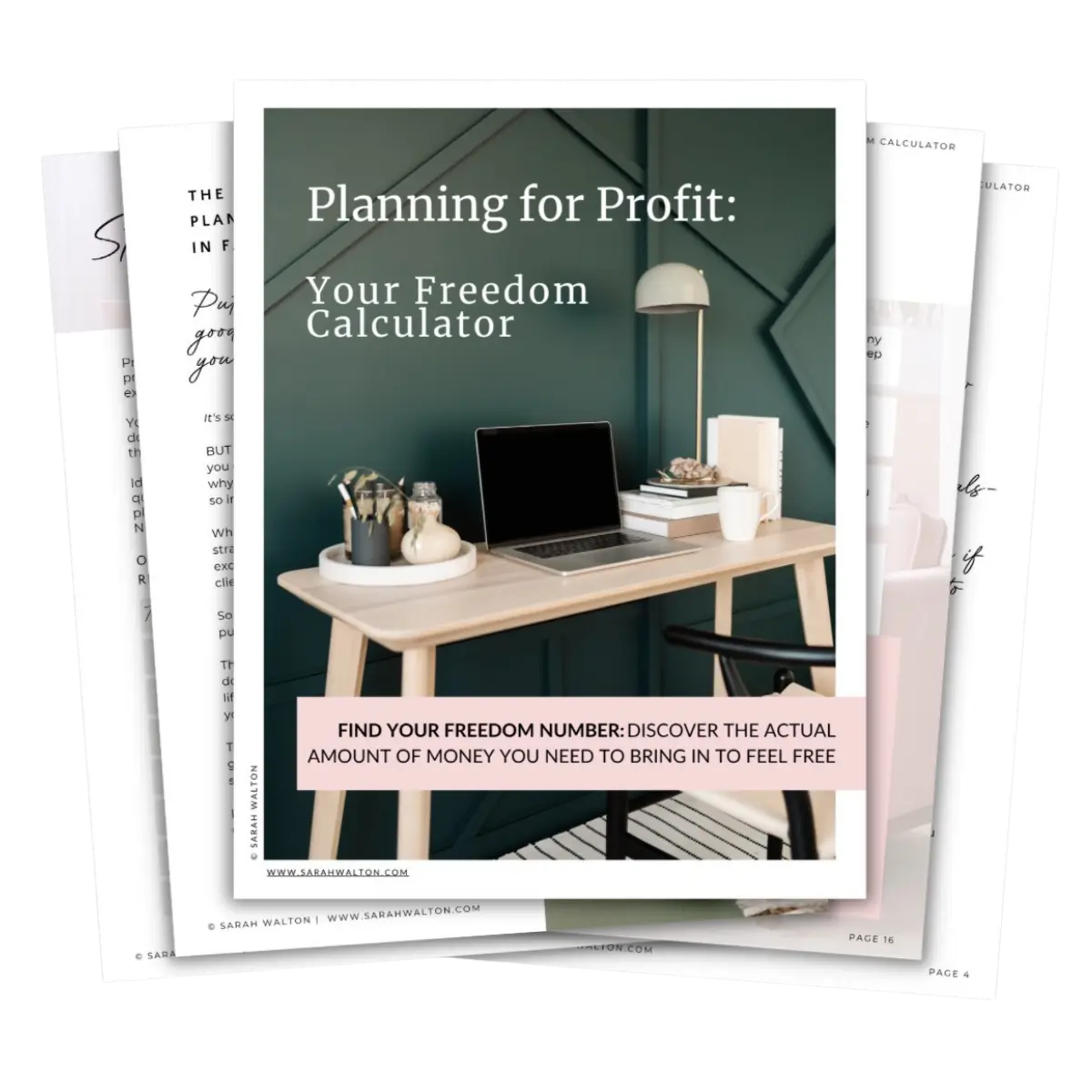
Freedom Calculator
Download my FREEDOM CALCULATOR and discover how much your business needs to make so you can finally be FREE.
Learn the exact number you need to feel free
Know what you need to do daily to make more money
Know what you need to do daily to make more money
Avoid the most common mistakes business owners make
It’s time to move from “fingers crossed” to clear and successful.